15 mins Reading
How Healthcare Facilities Can Strengthen Compliance Through Asset-Centered Inspections, Preventive Maintenance, and Audit-Ready Documentation
Joint Commission readiness is often treated as a periodic event. Many healthcare organizations increase their preparation efforts when a survey window approaches, gather documentation from different departments, review binders, chase missing inspection forms, and try to resolve outstanding deficiencies before surveyors arrive.
This approach creates unnecessary pressure for facilities, biomedical engineering, safety, nursing, IT, and compliance teams. More importantly, it does not reflect the true nature of healthcare compliance. Joint Commission readiness is not a one-time project. It is a daily operating discipline.
Published: 1 June 2026
Hospitals are responsible for maintaining life-critical assets, completing recurring inspections, documenting preventive maintenance, tracking corrective actions, and proving that safety-related work was completed properly. These responsibilities touch nearly every part of the physical environment, including biomedical equipment, emergency power, medical gas, fire protection, eyewash stations, patient rooms, nursing stations, medication refrigerators, IT closets, utility rooms, and Environment of Care rounds.
When these workflows are managed through paper forms, spreadsheets, emails, shared folders, and disconnected work order systems, healthcare teams face several risks: missed inspections, incomplete records, inconsistent documentation, weak accountability, and stressful survey preparation.
A modern compliance strategy requires a more connected model. Digital inspection workflows, QR-coded asset records, preventive maintenance schedules, mobile documentation, corrective action tracking, and audit-ready reporting can help healthcare organizations move from reactive survey preparation to continuous compliance readiness.
Linq Comply is designed around this operational reality. It helps healthcare teams organize inspections, assets, preventive maintenance, corrective actions, and compliance documentation in one connected platform. The goal is simple: make compliance work easier to complete, easier to manage, and easier to prove. The content foundation for the Linq Comply page emphasizes exactly this shift from manual paperwork toward digital workflows, survey preparation, standardized inspections, corrective action tracking, and multi-facility visibility.
1. The Compliance Challenge in Modern Healthcare Facilities
Healthcare facilities are complex operating environments. A hospital is not only a clinical setting; it is also a highly regulated physical infrastructure system. Behind patient care are thousands of assets, rooms, systems, devices, utilities, and safety checkpoints that must be maintained, inspected, documented, and corrected when deficiencies are found.
A typical hospital compliance environment may include:
· Biomedical and HTM equipment
· Emergency generators
· Fire extinguishers and fire doors
· Smoke barriers and egress routes
· Medical gas systems
· HVAC and critical ventilation systems
· Medication refrigerators
· Crash carts and defibrillators
· Eyewash stations
· Water systems
· Utility rooms
· IT/data closets
· Patient rooms
· Nursing stations
· Kitchens and food service areas
· Infection prevention inspection areas
· Environment of Care rounds
Each of these areas may have its own inspection frequency, responsible department, documentation requirement, and corrective action process. Some checks are daily. Others are weekly, monthly, quarterly, semiannual, or annual. Some are performed by facilities teams. Others are handled by biomedical engineering, nursing, pharmacy, environmental services, IT, safety officers, or outside vendors.
This creates a major coordination problem. Even when each team is doing its work, documentation can still become fragmented. A completed inspection may live in a binder. A failed item may be written on a paper form. A corrective action may be sent by email. A work order may be created in a CMMS. A photo may be stored on someone’s phone. A manager may track open issues in a spreadsheet.
During normal operations, this fragmentation is inconvenient. During a survey, it becomes a risk.
2. Why Manual Compliance Processes Break Down
Many healthcare organizations still rely on manual or semi-manual compliance processes. These processes are familiar, but they create hidden weaknesses.
Paper Forms Are Difficult to Track
Paper checklists may be simple to use, but they are hard to search, trend, validate, and retrieve. If a surveyor asks for evidence of completed inspections over a specific time period, teams may have to manually locate binders, scan pages, confirm signatures, and verify dates.
Spreadsheets Do Not Create Strong Accountability
Spreadsheets are useful for organizing information, but they are not ideal for controlled compliance workflows. They do not naturally enforce required fields, timestamps, user accountability, photos, signatures, or corrective action closure.
Emails Do Not Provide a Reliable Audit Trail
Email is often used to notify someone of an issue, but it is not a structured compliance system. Important details can be lost, forwarded, deleted, or buried in inboxes.
Disconnected Systems Create Documentation Gaps
A hospital may have a CMMS, a document system, a safety checklist process, a biomedical maintenance system, and department-level spreadsheets. If these systems do not connect, leadership may not have a complete view of risk, overdue work, or unresolved deficiencies.
Survey Preparation Becomes Reactive
When records are scattered, teams often prepare for surveys by manually collecting documentation at the last minute. This creates stress and can distract from the actual purpose of compliance: maintaining a safe and reliable healthcare environment every day.
3. The Shift: From Survey Preparation to Continuous Readiness
The better model is continuous readiness.
Continuous readiness means compliance evidence is created as part of daily work. Instead of preparing documentation only before a survey, the organization maintains clean records throughout the year.
This requires a shift in mindset:
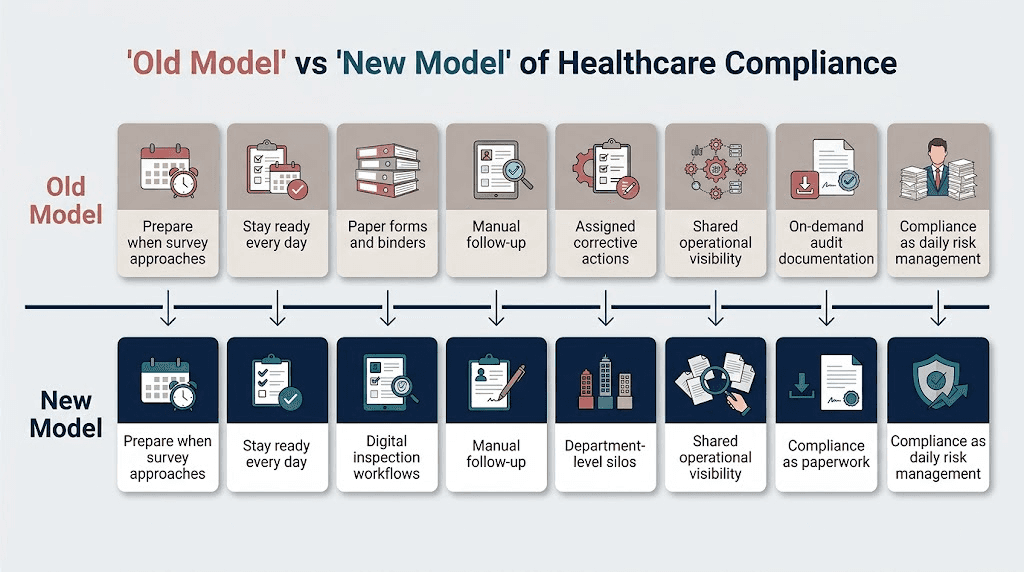
Continuous readiness does not mean more work. In many cases, it means the same work is performed in a more structured and visible way.
The inspection still happens. The PM still happens. The corrective action still happens. The difference is that the evidence is captured digitally, tied to the right asset or location, and available when needed.
4. Why Asset-Centered Compliance Matters
A major weakness in many compliance programs is that documentation is separated from the asset or location it relates to.
For example, a medical refrigerator temperature log may exist as a form, but it may not be tied to the refrigerator’s asset record, serial number, department, location, alarm history, PM record, or corrective action history. An eyewash inspection may be completed, but the failed item may not be linked to the specific station, work order, photo, or resolution. A crash cart check may be documented, but the seal number, department, shift, and issue history may not be easy to retrieve.
Asset-centered compliance solves this problem.
In an asset-centered model, every inspection, PM, issue, photo, reading, work order, and corrective action is connected to the asset or location. This creates a more complete history.
For example:
· A technician scans a QR code on an eyewash station.
· The Linq mobile app opens the correct inspection form.
· The technician records water flow, accessibility, signage, temperature, and condition.
· If an item fails, the system creates a corrective action.
· A work order is assigned to the responsible team.
· The corrective action is completed and documented.
· The full history remains connected to that eyewash station.
This is stronger than a standalone checklist because it creates traceability.
The same model can apply to crash carts, defibrillators, medical refrigerators, emergency generators, fire doors, patient rooms, IT closets, and utility assets.
5. Key Components of a Digital Joint Commission Readiness Platform
A strong digital compliance platform should support more than checklists. It should connect the people, assets, workflows, and records involved in healthcare compliance.
5.1 Digital Inspection Forms
Digital forms should replace paper checklists with structured workflows. These forms can include:
· Yes/No questions
· Pass/Fail fields
· Numeric readings
· Temperature fields
· Dropdown selections
· Required comments
· Photos
· Signatures
· Date and time stamps
· Inspector names
· Corrective action triggers
Standardized forms help ensure inspections are completed consistently across departments and facilities.
5.2 QR-Coded Assets
QR codes allow staff to access asset records directly from the field. Instead of searching for the correct form or asset ID, a technician can scan the asset and immediately view:
· Asset details
· Location
· Inspection forms
· PM schedule
· Open work orders
· Past inspection history
· Photos
· Documents
· Corrective actions
This improves speed, accuracy, and accountability.
5.3 Preventive Maintenance Scheduling
Preventive maintenance is central to healthcare compliance. A digital platform should allow PMs to be scheduled based on:
· Asset type
· Department
· Facility
· Location
· Risk level
· Manufacturer requirement
· Internal policy
· Regulatory frequency
· Inspection outcome
This helps teams reduce missed work and maintain better control over recurring tasks.
5.4 Corrective Action Management
Finding an issue is only the first step. A strong compliance program must prove that the issue was addressed.
Corrective action tracking should allow teams to:
· Create follow-up tasks from failed inspection answers
· Assign responsibility
· Set due dates
· Track status
· Add photos and notes
· Document resolution
· Review open and overdue items
· Preserve the full history
This is especially important because unresolved deficiencies can become compliance findings.
5.5 Audit-Ready Reporting
Audit-ready reporting allows teams to quickly retrieve the records they need. Reports may include:
· Completed inspections
· Missed inspections
· Overdue PMs
· Failed inspection items
· Corrective action status
· Asset history
· Department performance
· Facility-level compliance dashboards
· Survey documentation exports
The goal is to reduce the time spent searching for evidence and increase confidence in the completeness of records.
5.6 Multi-Facility Visibility
For health systems with multiple hospitals, clinics, or campuses, compliance visibility becomes even more important. Leadership needs to know where risks exist across the organization.
A multi-facility platform can help compare:
· Inspection completion rates
· Open corrective actions
· Overdue PMs
· High-risk assets
· Department-level compliance status
· Facility-level readiness
This allows leadership to manage compliance as an enterprise function rather than a series of disconnected local processes.
6. Practical Healthcare Workflows That Should Be Digitized
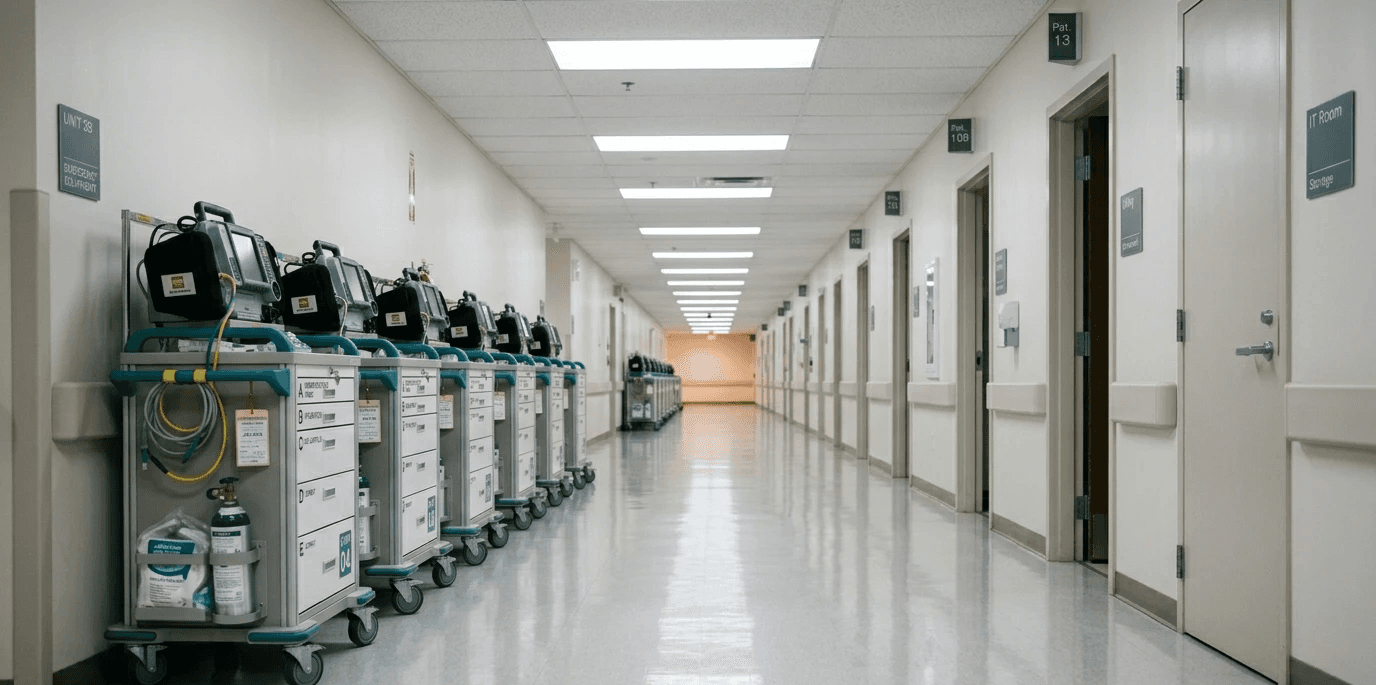
Not every workflow needs to be digitized at once. A practical approach is to start with high-risk, high-frequency, or survey-sensitive workflows.
Examples include:
Eyewash Station Inspections
Eyewash stations require recurring checks to confirm accessibility, signage, flow, cleanliness, and functionality. Digital workflows can capture readings, issues, photos, and corrective actions.
Medical Refrigerator Temperature Logs
Medication and specimen refrigerators require consistent temperature monitoring. Digital forms can capture AM/PM readings, out-of-range temperatures, alarm status, comments, and follow-up actions.
Crash Cart Checks
Crash cart inspections can include seal numbers, expiration checks, accessibility, supply status, and documentation of deficiencies.
Defibrillator Inspections
Defibrillator workflows can track readiness, battery status, pads, cables, alarm indicators, and PM history.
Patient Room Inspections
Patient room checks may include environmental conditions, safety features, call buttons, oxygen outlets, suction ports, cleanliness, and visible damage.
IT/Data Closet Inspections
IT closets may require checks for temperature, humidity, access control, fire safety, cable management, unauthorized storage, and environmental risks.
Environment of Care Rounds
Environment of Care rounds can cover patient safety risks, physical environment issues, egress, storage, cleanliness, utilities, fire safety, and department-level compliance concerns.
Emergency Generator and Utility System Checks
Critical utility systems require strong documentation because they directly affect patient safety and operational continuity.
Fire and Life Safety Inspections
Fire doors, extinguishers, sprinkler systems, emergency lighting, exit signs, and egress paths can be tracked digitally with location-based records and corrective actions.
7. How Linq Comply Supports Continuous Compliance
Linq Comply is designed to help healthcare organizations move from fragmented documentation to connected compliance operations.
The platform brings together:
· Asset management
· QR-coded asset identification
· Mobile inspections
· Preventive maintenance
· Work orders
· Corrective actions
· Digital documentation
· Dashboards
· Reporting
· System integrations
This allows hospitals to manage compliance work where it actually happens: in the field, at the asset, in the room, in the department, and across the facility.
Mobile Inspection Execution
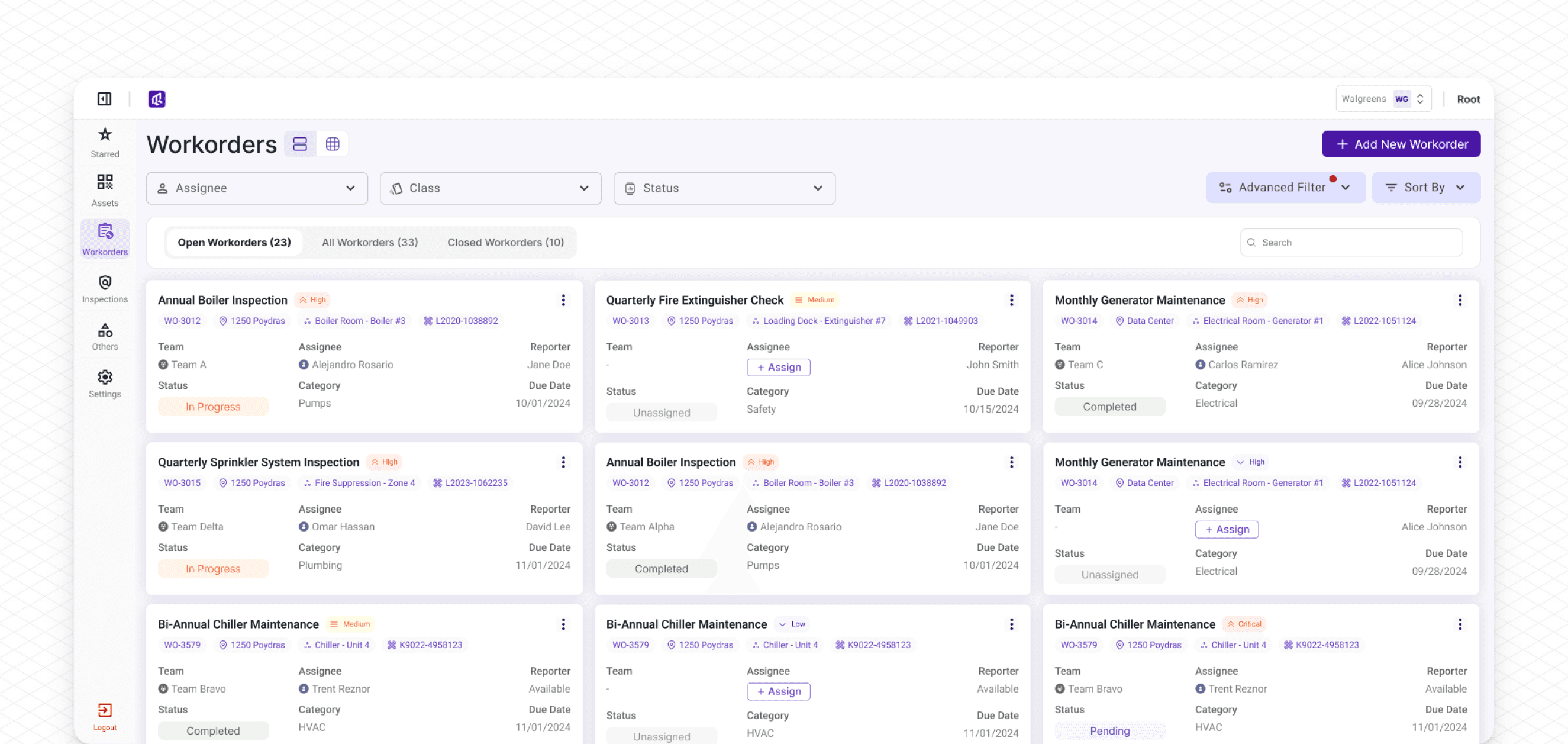
Technicians and inspectors can complete forms directly from the Linq mobile app. This allows documentation to be captured at the point of work rather than recreated later.
Asset-Level Traceability
Each asset can have a complete history, including inspections, PMs, failures, work orders, corrective actions, photos, and lifecycle data.
Connected Corrective Actions
When an inspection fails, Linq can help create a structured follow-up process so issues are not forgotten or left unresolved.
Compliance Dashboards
Managers can review completion rates, overdue work, open issues, and readiness trends from one place.
Integration with Existing Systems
Linq can support enterprise workflows by connecting with existing CMMS, ERP, and work order platforms. This helps organizations improve compliance without forcing a full replacement of systems already in place.
8. The Leadership Value: Better Visibility, Better Accountability, Better Readiness
For healthcare executives and facility leaders, compliance technology should not only help front-line staff complete tasks. It should also provide leadership visibility.
A strong digital compliance system can help answer important operational questions:
· Which inspections are overdue?
· Which departments have the most open corrective actions?
· Which assets are repeatedly failing inspections?
· Which facilities are falling behind?
· Are PMs being completed on schedule?
· Are failures being resolved quickly?
· Can we produce documentation quickly if requested?
· Are we improving over time?
These questions are difficult to answer when records are spread across paper forms, spreadsheets, emails, and disconnected systems.
With digital workflows, leadership can manage compliance with better information. This supports better planning, better resource allocation, and stronger accountability.
9. Why This Matters for Patient Safety

Compliance documentation is not only an administrative requirement. It is connected to patient safety.
A missed refrigerator temperature check could affect medication integrity. A blocked eyewash station could delay emergency response. A failed emergency generator inspection could create risk during power loss. A broken call button could affect patient response time. A missed defibrillator check could compromise emergency readiness.
Digital compliance workflows help reduce these risks by making inspections easier to complete, failures easier to identify, and corrective actions easier to track.
The purpose is not just to produce better reports. The purpose is to create a safer, more reliable healthcare environment.
10. Recommended Implementation Approach
Healthcare organizations do not need to digitize every compliance workflow on day one. A phased approach is usually more effective.
Phase 1: Identify High-Risk Workflows
Start with workflows that are frequent, survey-sensitive, or directly connected to patient safety. Examples include eyewash stations, crash carts, medical refrigerators, Environment of Care rounds, emergency generators, and fire/life safety assets.
Phase 2: Build the Asset Registry
Create or clean up the asset list. Include asset name, type, location, department, QR code, manufacturer, model, serial number, risk level, and inspection requirements where applicable.
Phase 3: Configure Digital Forms
Convert current paper forms and spreadsheets into structured digital inspection forms. Keep them practical and field-friendly.
Phase 4: Assign Responsibilities
Define who performs each inspection, who reviews failures, who owns corrective actions, and who approves completed work.
Phase 5: Launch Mobile Workflows
Train inspectors and technicians to use the mobile app, scan QR codes, complete forms, attach photos, and document issues.
Phase 6: Monitor Dashboards
Use dashboards to track completion rates, overdue items, failed inspections, and corrective action closure.
Phase 7: Expand Across Departments
After early workflows are stable, expand into more departments, more asset types, and more facilities.
11. Common Mistakes to Avoid
Digitizing Bad Processes Without Improving Them
Simply moving a paper form into a digital format is not enough. The workflow should be reviewed and improved before digitization.
Making Forms Too Long
Long forms can reduce field adoption. Forms should be clear, practical, and focused on the required inspection outcome.
Not Connecting Failures to Corrective Actions
A failed inspection item should not just sit in a report. It should trigger follow-up.
Ignoring Asset Data Quality
If asset records are incomplete or inaccurate, compliance workflows become harder to manage. Clean asset data is a foundation for strong compliance.
Treating Compliance as Only a Facilities Issue
Healthcare compliance involves facilities, biomedical engineering, nursing, safety, IT, infection prevention, pharmacy, and leadership. The system should support cross-functional accountability.
12. Conclusion: The Future of Joint Commission Readiness Is Continuous, Digital, and Asset-Centered
Healthcare compliance is becoming too complex for manual processes. Hospitals are managing more assets, more documentation, more risk, and more operational pressure than ever before.
The organizations that perform best will be the ones that treat compliance as a daily operating system, not a last-minute survey project.
Digital workflows help make this possible. By connecting inspections, assets, PMs, corrective actions, mobile documentation, and audit-ready reporting, healthcare teams can create a stronger foundation for continuous readiness.
Linq Comply supports this shift by helping hospitals manage life-critical assets and compliance workflows in one connected platform. It helps teams reduce paperwork, standardize inspections, improve accountability, close the loop on deficiencies, and maintain documentation that is ready when needed.
In healthcare, readiness should not begin when a survey is scheduled. Readiness should be built into the way the facility operates every day.
Linq Comply
Linq's asset intelligence platform gives healthcare facilities end-to-end control over every asset, from life-saving medical devices to critical infrastructure.