Linq Comply
The Joint Commission Compliance for Healthcare Facilities

Linq Comply
The Joint Commission Compliance for Healthcare Facilities

The Joint Commission Compliance, Built Into Daily Healthcare Operations

Linq Comply helps hospitals and healthcare facilities manage life-critical assets, inspections, preventive maintenance, and compliance documentation in one connected platform.

From biomedical equipment and emergency power systems to eyewash stations, crash carts, medical refrigerators, fire safety assets, and Environment of Care rounds, Linq gives healthcare teams the tools to stay organized, inspection-ready, and accountable every day.

Healthcare compliance is not just about passing a survey. It is about protecting patients, supporting technicians, reducing risk, and proving that the right work was completed at the right time with the right documentation.

Linq Comply helps hospitals and healthcare facilities manage life-critical assets, inspections, preventive maintenance, and compliance documentation in one connected platform.

From biomedical equipment and emergency power systems to eyewash stations, crash carts, medical refrigerators, fire safety assets, and Environment of Care rounds, Linq gives healthcare teams the tools to stay organized, inspection-ready, and accountable every day.

Healthcare compliance is not just about passing a survey. It is about protecting patients, supporting technicians, reducing risk, and proving that the right work was completed at the right time with the right documentation.

Machina AI automation dashboard showing workflow overview

Helping Healthcare Teams Stay Survey-Ready Without Manual Paperwork

Managing a modern hospital requires constant coordination across facilities, biomedical engineering, safety, nursing, IT, environmental services, and compliance teams. Each department is responsible for critical assets, recurring inspections, corrective actions, and documentation that may be reviewed during a Joint Commission survey.

Linq simplifies this work by converting paper checklists, spreadsheets, binders, and disconnected work orders into structured digital workflows. Teams can inspect assets from the field, document findings on mobile devices, attach photos, trigger corrective actions, and maintain a complete audit trail across the facility.

The result is a more organized compliance program with stronger visibility, cleaner documentation, and faster access to the records needed during internal reviews, mock surveys, and external audits.

Compliance Focus Areas

Built for the Assets and Inspections That Matter in Healthcare

Built for the Assets and Inspections That Matter in Healthcare

Linq supports the day-to-day operational areas that are essential to healthcare compliance and patient safety.

Linq supports the day-to-day operational areas that are essential to healthcare compliance and patient safety.

Biomedical & HTM Equipment

Manage preventive maintenance, calibration schedules, inspections, service history, and lifecycle records for diagnostic, therapeutic, and life-support equipment. Linq helps biomedical and HTM teams maintain consistent documentation and reduce the risk of missed work.

TJC EC.02.04.01, EC.02.04.03; NFPA 99; CMS 42 CFR §482.41

Environment of Care Rounds

Digitize recurring Environment of Care inspections for patient rooms, nursing stations, utility rooms, corridors, IT closets, mechanical rooms, kitchens, and other high-risk areas. Standardized forms help teams identify issues before they become compliance findings.

TJC EC.02.01.01, EC.02.06.01, EC.04.01.01, EC.04.01.03; CMS 42 CFR §482.41

Life Safety & Fire Protection

Track inspections, testing, and maintenance for fire extinguishers, fire doors, smoke barriers, sprinkler systems, emergency lighting, egress routes, and other life safety assets. Linq helps teams maintain defensible documentation for life safety readiness.

TJC EC.02.03.01, EC.02.03.03, EC.02.03.05, LS.02.01.10, LS.02.01.20, LS.02.01.30, LS.02.01.35; NFPA 101, 10, 13, 25, 72, 80, 110

Utility Systems Management

Manage critical infrastructure including HVAC, emergency generators, electrical distribution, medical gas, boilers, pumps, water systems, and backup power assets. Linq provides visibility into inspection status, maintenance history, and corrective actions for essential utility systems.

TJC EC.02.05.01, EC.02.05.03, EC.02.05.05, EC.02.05.07, EC.02.05.09; NFPA 99; NFPA 110; CMS 42 CFR §482.41

Emergency Equipment & Clinical Support Assets

Track hazardous material storage and disposal, ensuring compliance with EC.02.02.01 environmental safety standards.

TJC EC.02.04.03, MM.03.01.01, EC.02.02.01, EC.02.05.09; OSHA 29 CFR 1910.151(c); ANSI/ISEA Z358.1

Corrective Action Tracking

When an inspection fails, Linq can create a follow-up task or work order, assign responsibility, track completion, and preserve the full history of the issue. This helps facilities move from “finding problems” to proving that problems were resolved.

TJC PI.01.01.01, PI.02.01.01, PI.03.01.01, EC.04.01.01, EC.04.01.03, LD standards; CMS 42 CFR §482.21

FEATURES

What Linq Comply Helps You Do

How it works

From Field Inspection to Compliance Record
  • Build the Asset Registry

    Linq helps create a structured inventory of critical healthcare assets, including biomedical equipment, utility systems, life safety assets, room-based assets, and department-level inspection points.

    1

  • Assign QR Codes and Locations

    Each asset can be assigned a QR code and tied to its exact facility, floor, department, room, or asset group. This makes field access simple and improves location-based accountability.

    2

  • Configure Inspection and PM Workflows

    Inspection forms and PM schedules can be configured by asset type, department, frequency, and risk level. Examples include daily, weekly, monthly, quarterly, semiannual, and annual workflows.

    3

  • Complete Work in the Field

    Technicians and inspectors use the Linq app to scan, inspect, document, and submit work. Forms can include yes/no questions, numeric readings, temperature fields, dropdowns, comments, photos, and signatures.

    4

  • Trigger Corrective Actions

    Failed inspection items can create follow-up tasks or work orders. This ensures issues are assigned, tracked, and resolved with documented accountability.

    5

  • Review Dashboards and Reports

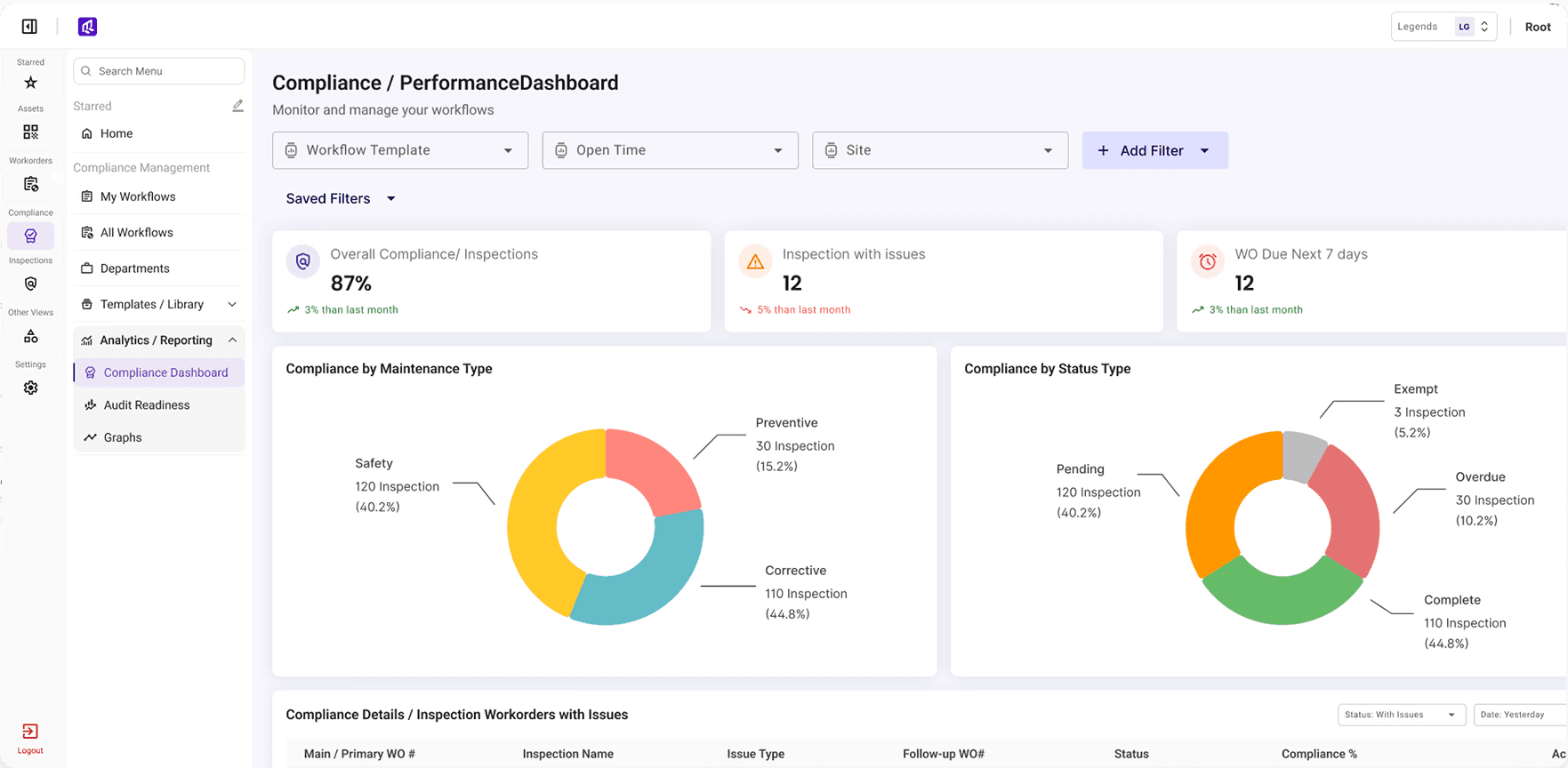
    Managers can monitor completion rates, open issues, overdue inspections, asset risk, PM compliance, and survey readiness from dashboards and reports.

    6

  • Produce Audit Documentation

    When surveyors, leadership, or internal compliance teams request documentation, Linq provides searchable records and exportable reports.

    7

  • Build the Asset Registry

    Linq helps create a structured inventory of critical healthcare assets, including biomedical equipment, utility systems, life safety assets, room-based assets, and department-level inspection points.

    1

  • Assign QR Codes and Locations

    Each asset can be assigned a QR code and tied to its exact facility, floor, department, room, or asset group. This makes field access simple and improves location-based accountability.

    2

  • Configure Inspection and PM Workflows

    Inspection forms and PM schedules can be configured by asset type, department, frequency, and risk level. Examples include daily, weekly, monthly, quarterly, semiannual, and annual workflows.

    3

  • Complete Work in the Field

    Technicians and inspectors use the Linq app to scan, inspect, document, and submit work. Forms can include yes/no questions, numeric readings, temperature fields, dropdowns, comments, photos, and signatures.

    4

  • Trigger Corrective Actions

    Failed inspection items can create follow-up tasks or work orders. This ensures issues are assigned, tracked, and resolved with documented accountability.

    5

  • Review Dashboards and Reports

    Managers can monitor completion rates, open issues, overdue inspections, asset risk, PM compliance, and survey readiness from dashboards and reports.

    6

  • Produce Audit Documentation

    When surveyors, leadership, or internal compliance teams request documentation, Linq provides searchable records and exportable reports.

    7

  • Build the Asset Registry

    Linq helps create a structured inventory of critical healthcare assets, including biomedical equipment, utility systems, life safety assets, room-based assets, and department-level inspection points.

    1

  • Assign QR Codes and Locations

    Each asset can be assigned a QR code and tied to its exact facility, floor, department, room, or asset group. This makes field access simple and improves location-based accountability.

    2

  • Configure Inspection and PM Workflows

    Inspection forms and PM schedules can be configured by asset type, department, frequency, and risk level. Examples include daily, weekly, monthly, quarterly, semiannual, and annual workflows.

    3

  • Complete Work in the Field

    Technicians and inspectors use the Linq app to scan, inspect, document, and submit work. Forms can include yes/no questions, numeric readings, temperature fields, dropdowns, comments, photos, and signatures.

    4

  • Trigger Corrective Actions

    Failed inspection items can create follow-up tasks or work orders. This ensures issues are assigned, tracked, and resolved with documented accountability.

    5

  • Review Dashboards and Reports

    Managers can monitor completion rates, open issues, overdue inspections, asset risk, PM compliance, and survey readiness from dashboards and reports.

    6

  • Produce Audit Documentation

    When surveyors, leadership, or internal compliance teams request documentation, Linq provides searchable records and exportable reports.

    7

Compliance Visibility Across the Entire Facility

Healthcare compliance becomes difficult when documentation is scattered across paper forms, spreadsheets, emails, binders, and separate maintenance systems. Linq brings asset data, inspection activity, PM schedules, corrective actions, and compliance records into one connected view.

With Linq, leadership can see what has been completed, what is overdue, where risk exists, and which departments need follow-up. This creates stronger accountability across facilities, biomedical engineering, safety, nursing, IT, and compliance teams.

The Joint Commission’s own materials emphasize the importance of standardized measures, data quality, sampling, missing or invalid data handling, and performance improvement documentation. Linq’s value is not to replace regulatory requirements, but to help healthcare teams collect, organize, and retrieve operational compliance evidence more reliably.

Contact us

Partner, Not a Vendor

Linq works with enterprise teams to understand their facilities, assets, workflows, and compliance requirements before configuring a practical solution. Whether you are improving asset data, modernizing inspections, strengthening compliance, or connecting systems, our team can help you determine the best starting point.

Industries

Healthcare

Corporate Campuses

Commercial Properties

Stadiums & Event Venues

Industrial Sites

Public Sector

Resources

Case Studies

Implementation Process

Security & Integrations

2026 Linq.io. All rights reserved.

Contact us

Partner, Not a Vendor

Linq works with enterprise teams to understand their facilities, assets, workflows, and compliance requirements before configuring a practical solution. Whether you are improving asset data, modernizing inspections, strengthening compliance, or connecting systems, our team can help you determine the best starting point.

Industries

Healthcare

Corporate Campuses

Commercial Properties

Stadiums & Event Venues

Industrial Sites

Public Sector

Resources

Case Studies

Implementation Process

Security & Integrations

2026 Linq.io. All rights reserved.

Contact us

Partner, Not
a Vendor

Linq works with enterprise teams to understand their facilities, assets, workflows, and compliance requirements before configuring a practical solution. Whether you are improving asset data, modernizing inspections, strengthening compliance, or connecting systems, our team can help you determine the best starting point.

Industries

Healthcare

Corporate Campuses

Commercial Properties

Stadiums & Event Venues

Industrial Sites

Public Sector

Resources

Case Studies

Implementation Process

Security & Integrations

2026 Linq.io. All rights reserved.

Create a free website with Framer, the website builder loved by startups, designers and agencies.